
Euler’s Identity Isn’t Magic — It’s Geometry
Published:
By: Rajib Belbase
Abstract. Euler’s Identity \(e^{i\pi} + 1 = 0\) is frequently celebrated as the most beautiful equation in mathematics. But its beauty is not mystical. This article dismantles the mysticism and replaces it with something far more satisfying: a rigorous geometric explanation grounded in complex analysis, Taylor series, and the structure of the complex plane. We build every prerequisite from scratch, prove Euler’s formula in full, and examine why the identity is not a coincidence but an inevitability.
1. Introduction
Few equations in mathematics have attracted as much popular attention as Euler’s Identity:
\[e^{i\pi} + 1 = 0\]It has been called “the most remarkable formula in mathematics” by Richard Feynman [1], voted the greatest equation of all time in a poll of physicists [2], and tattooed on the forearms of countless undergraduates. But the framing around it — five fundamental constants, one miraculous equation — obscures more than it reveals.
The identity is not a lucky coincidence. It is a direct consequence of how exponentiation extends to the complex plane. Once you understand that extension, the identity becomes obvious — not in the pejorative sense, but in the sense that it could not be any other way.
This article builds the full picture from first principles. We assume familiarity with real calculus, basic series, and the concept of complex numbers. We do not assume any prior knowledge of complex analysis.
2. Preliminaries
Before we can understand Euler’s formula, we need four building blocks in place: the exponential function, complex numbers, Taylor series, and trigonometric functions. Each is treated rigorously below.
2.1 The Real Exponential Function
The exponential function f(x) = eˣ can be defined in several equivalent ways. For our purposes, the most useful definition is the power series:
This series converges absolutely for every x ∈ ℝ, and indeed for every x ∈ ℂ (we will use this shortly). The key properties that follow from this definition are:
e⁰ = 1d/dx [eˣ] = eˣe^(a+b) = eᵃ · eᵇfor alla, b
Property (2) follows by differentiating the series term-by-term (justified by uniform convergence on compact sets [3]). Property (3) follows from the Cauchy product of two absolutely convergent series [3].
2.2 Complex Numbers
A complex number z ∈ ℂ is written z = a + bi, where a, b ∈ ℝ and i² = -1. We identify ℂ with ℝ² via the map a + bi ↦ (a, b), giving ℂ a natural geometric interpretation as the complex plane.
The modulus of z = a + bi is |z| = √(a² + b²), and the argument is arg(z) = θ = arctan(b/a). Every nonzero complex number can be written in polar form:
Multiplication in polar form has a clean geometric meaning: multiplying two complex numbers multiplies their moduli and adds their arguments. That is, if z₁ = r₁e^(iθ₁) and z₂ = r₂e^(iθ₂), then:
This geometric interpretation — multiplication as rotation and scaling — is the core insight that makes everything that follows inevitable.
2.3 Taylor Series
If a function f is infinitely differentiable at a point a, its Taylor series centered at a is:
When a = 0, this is called the Maclaurin series. We will use three Maclaurin series repeatedly:
All three series converge absolutely for all x ∈ ℝ, and — critically — for all x ∈ ℂ [4]. This absolute convergence is what allows us to substitute a complex number into the series for eˣ without any loss of validity.
2.4 The Complex Exponential
We define the complex exponential by substituting z ∈ ℂ directly into the power series for eˣ:
This is not an extension by analogy — it is the same formula, applied over ℂ instead of ℝ. The absolute convergence of the series on ℂ guarantees this definition is well-posed [4]. All the algebraic properties (1)–(3) from Section 2.1 continue to hold for the complex exponential.
3. Euler’s Formula: The Full Proof
We are now ready to prove Euler’s Formula:
\[\boxed{e^{i\theta} = \cos\theta + i\sin\theta \quad \text{for all } \theta \in \mathbb{R}}\]The proof is a direct computation using the series definition from Section 2.4.
3.1 Proof by Series Expansion
Substitute z = iθ into the series for eᶻ:
Expand the powers of i. Recall that i⁰=1, i¹=i, i²=-1, i³=-i, i⁴=1, …. Substituting:
Now separate real and imaginary parts:
\[\text{Real:}\quad 1 - \frac{\theta^2}{2!} + \frac{\theta^4}{4!} - \frac{\theta^6}{6!} + \cdots = \cos\theta\] \[\text{Imaginary:}\quad \theta - \frac{\theta^3}{3!} + \frac{\theta^5}{5!} - \frac{\theta^7}{7!} + \cdots = \sin\theta\]Recognizing the Maclaurin series from Section 2.3, we conclude:
\[e^{i\theta} = \cos\theta + i\sin\theta \qquad \blacksquare\]The rearrangement of terms is justified because all series involved are absolutely convergent [3, 4].
3.2 Geometric Interpretation
Euler’s formula says that e^(iθ) is the point on the unit circle in the complex plane at angle θ from the positive real axis. As θ varies, e^(iθ) traces the unit circle.
This means that multiplying by e^(iθ) is a rotation by θ radians. Exponentiation with an imaginary argument is not some strange number-theoretic quirk — it is the natural language of rotation in ℂ. This is why the complex exponential is so central to physics, signal processing, and quantum mechanics: oscillatory phenomena are geometrically circular.
4. Euler’s Identity as a Special Case
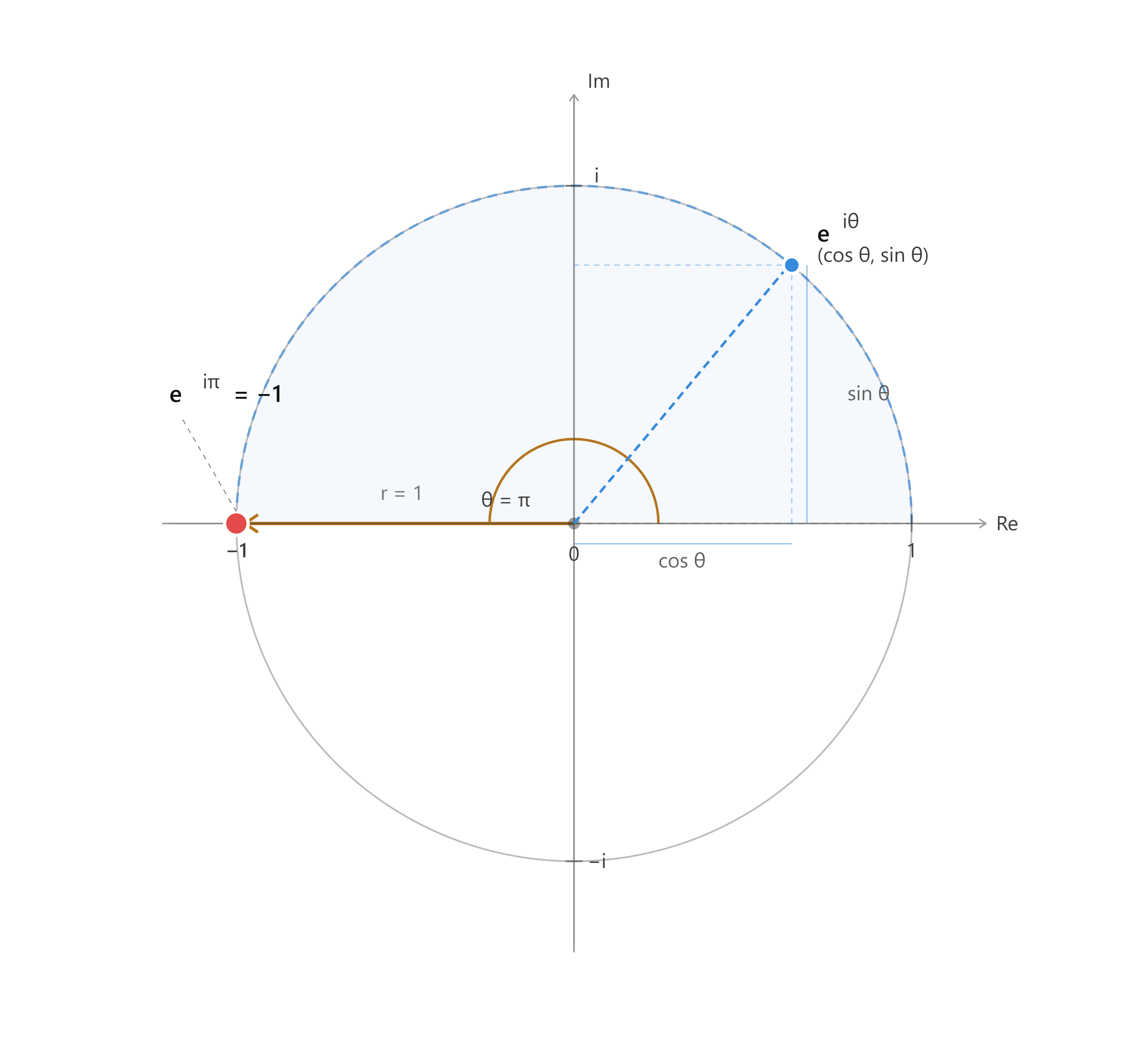 Figure 1: The complex plane showing how \(e^{i\theta}\) traces a circle, reaching -1 at \(\pi\) radians.
Euler’s Identity follows immediately by substituting θ = π into Euler’s Formula:
Therefore:
\[\boxed{e^{i\pi} + 1 = 0}\]That is all. The equations cos π = -1 and sin π = 0 are elementary facts about the unit circle: at angle π radians (180°), you are at the point (-1, 0) in the plane, i.e., the real number -1. The identity is the statement that rotating by half a turn brings you to -1. Nothing more.
4.1 Why These Five Constants?
Let us address the “five constants” framing directly. The presence of e, i, π, 1, and 0 in the same equation is often treated as cosmically significant. It is worth being precise about what is actually happening:
| Constant | Why it appears |
|---|---|
| e | The complex exponential is defined via the same power series as the real exponential. e is baked in by definition. |
| i | We evaluate the exponential at an imaginary argument, which is what moves us onto the unit circle. |
| π | π radians is the angle corresponding to the point (-1, 0) on the unit circle — a half rotation. |
| 1 | In e^(iπ) + 1 = 0, the 1 appears simply because e^(iπ) = -1; adding 1 to both sides gives the symmetric form. |
| 0 | Appears on the right-hand side because -1 + 1 = 0. It signals balance, not magic. |
The constants do not conspire. They are all consequences of the same geometric fact: the unit circle in the complex plane, parametrized by the complex exponential.
5. Why the Formula Matters
Euler’s formula is not merely elegant — it is operationally indispensable. Here are three domains where it is foundational.
5.1 Fourier Analysis
The Fourier transform decomposes functions into frequency components. The basis functions are e^(2πiξt), which by Euler’s formula equal cos(2πξt) + i sin(2πξt) — sinusoidal oscillations. The complex exponential is the natural language for oscillation [5].
5.2 Quantum Mechanics
The time evolution of a quantum state is governed by the Schrödinger equation, whose solutions are of the form Ψ(t) = e^(-iHt/ℏ)Ψ(0), where H is the Hamiltonian operator. The complex exponential encodes interference, phase, and wave behavior — all geometric phenomena in ℂ [6].
5.3 Signal Processing
In electrical engineering and digital signal processing, signals are routinely represented as complex exponentials. The phasor representation A·e^(iφ) encodes both amplitude A and phase φ in a single complex number. Circuit analysis becomes algebra in ℂ [7].
6. Conclusion
Euler’s Identity is beautiful. But its beauty is not the beauty of coincidence — it is the beauty of inevitability. Once you define the complex exponential by its power series, once you recognize that the imaginary axis corresponds to rotation, and once you note that π radians is a half-turn to the point -1, the identity follows with no room for surprise.
The real depth lies not in the identity itself but in what it reveals: that exponentiation, rotation, and trigonometry are the same phenomenon, viewed through different lenses. The complex plane unifies them. Euler’s formula is the rosetta stone.
“It is absolutely paradoxical; we cannot understand it, and we don’t know what it means, but we have proved it, and therefore we know it must be the truth.” — Benjamin Peirce, on Euler’s Identity [8]
Peirce was being characteristically dramatic. We do know what it means. It means the unit circle.
References
[1] Feynman, R. P. (1970). The Feynman Lectures on Physics, Vol. I. Addison-Wesley. Chapter 22: Algebra.
[2] Nahin, P. J. (2006). Dr. Euler’s Fabulous Formula: Cures Many Mathematical Ills. Princeton University Press. ISBN 978-0-691-11822-2.
[3] Rudin, W. (1976). Principles of Mathematical Analysis, 3rd ed. McGraw-Hill. Chapters 3 & 7.
[4] Ahlfors, L. V. (1979). Complex Analysis, 3rd ed. McGraw-Hill. Chapter 2.
[5] Stein, E. M., & Shakarchi, R. (2003). Fourier Analysis: An Introduction. Princeton University Press. Chapter 1.
[6] Dirac, P. A. M. (1958). The Principles of Quantum Mechanics, 4th ed. Oxford University Press. Chapter 4.
[7] Oppenheim, A. V., & Schafer, R. W. (2009). Discrete-Time Signal Processing, 3rd ed. Prentice Hall. Chapter 2.
[8] Peirce, B. (1881). “On the Uses and Transformations of Linear Algebra.” Proceedings of the American Academy of Arts and Sciences, 16, 395–402.

