
A Foundational Review of Functions
Published:
By: Rajib Belbase
For students in Calculus I. This post covers the foundational concepts of functions required for Calculus. We explore how to represent functions, determine domains and ranges, and apply transformations. All material follows Sections 1.1–1.3 of Calculus, 9th edition, by James Stewart.
1. What is a Function?
A function \(f\) is a rule that assigns to each element \(x\) in a set \(D\) (the domain) exactly one element, called \(f(x)\), in a set \(E\) (the codomain).
When working with functions algebraically, there are two primary Domain Restrictions to keep in mind:
- Rational Functions: The denominator cannot be zero.
- Radical Functions: The expression under a square root (or any even root) must be greater than or equal to zero.
1.1 The Four Ways to Represent a Function
According to Stewart §1.1, functions can be described in four ways:
- Verbally (description in words)
- Numerically (table of values)
- Visually (graph)
- Algebraically (explicit formula)
1.2 The Vertical Line Test
A curve in the \(xy\)-plane is the graph of a function of \(x\) if and only if no vertical line intersects the curve more than once. If a vertical line intersects a curve at more than one point, the curve does not represent a function because one input would result in multiple outputs.
2. New Functions from Old (Transformations)
By applying transformations to a “parent” function (such as \(f(x) = x^2\) or \(f(x) = \sqrt{x}\)), we can model a wide variety of phenomena.
2.1 Shifting
- Vertical Shifts: \(y = f(x) + c\) moves the graph up \(c\) units; \(y = f(x) - c\) moves it down.
- Horizontal Shifts: \(y = f(x - c)\) moves the graph right \(c\) units; \(y = f(x + c)\) moves it left.
2.2 Function Composition
The composite function \(f \circ g\) is created by using the output of one function as the input for another: \((f \circ g)(x) = f(g(x))\)
Note on Domain: The domain of the composition \(f \circ g\) consists of all \(x\) in the domain of \(g\) such that \(g(x)\) is in the domain of \(f\).
3. Worked Examples
These examples illustrate the practical application of Stewart’s early chapters.
Example 1: Finding Domain and Range
Problem: Find the domain and range of the function \(f(x) = \sqrt{x - 2}\).
Solution:
- Domain: We require the radicand to be non-negative to avoid imaginary numbers: \(x - 2 \geq 0 \implies x \geq 2\) In interval notation, the domain is \([2, \infty)\).
- Range: The output of a square root is always non-negative. Since the minimum value of the radicand is 0, the range is \([0, \infty)\).
Example 2: Horizontal and Vertical Shifting
Problem: Use the graph of \(g(x) = x^2\) to sketch \(h(x) = (x + 3)^2 - 5\).
Solution:
- Parent Function: Start with the standard parabola \(y = x^2\) (vertex at \((0,0)\)).
- Horizontal Shift: Replace \(x\) with \((x+3)\), which shifts the graph 3 units to the left.
- Vertical Shift: Subtract 5 from the result, which shifts the graph 5 units down.
- Final Vertex: The new vertex is located at \((-3, -5)\).
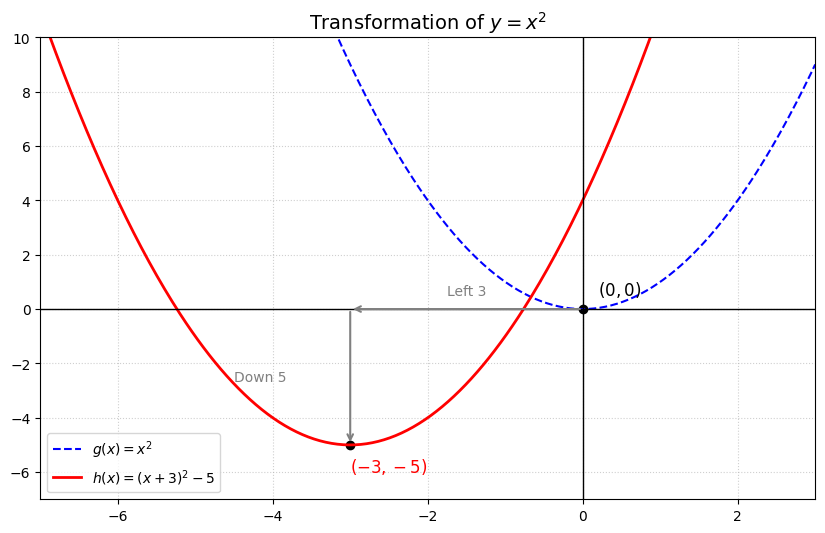
Notice the vertex moves left 3 and down 5.
Example 3: Composition of Functions
Problem: If \(f(x) = x^2\) and \(g(x) = x - 3\), find the formula for \((f \circ g)(x)\).
Solution: \((f \circ g)(x) = f(g(x))\) Substitute the expression for \(g(x)\) into the variable in function \(f\): \(f(x - 3) = (x - 3)^2\) Expanded, this result is \(x^2 - 6x + 9\).
4. Summary Table
| Concept | Key Definition |
|---|---|
| Mathematical Model | A mathematical description (often a function) of a real-world phenomenon. |
| Even Function | \(f(-x) = f(x)\). The graph is symmetric about the \(y\)-axis. |
| Odd Function | \(f(-x) = -f(x)\). The graph is symmetric about the origin. |
| Domain Restriction | Check for zeros in denominators and negatives in even roots. |
References
All section numbers refer to:
Stewart, J. (2021). Calculus, 9th edition. Cengage Learning.
- §1.1 — Four Ways to Represent a Function
- §1.2 — Mathematical Models: A Catalog of Essential Functions
- §1.3 — New Functions from Old Functions

